
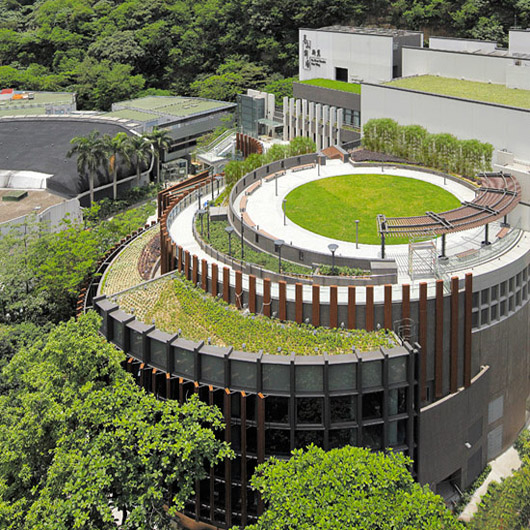
The green roof passive irrigation system described here stores rainwater below a planted area and returns moisture toward the growing medium through a passive path. In practice, whether it works on a particular roof depends on the complete design. Therefore, structure, waterproofing, drainage, overflow, water quality, planting, access and maintenance still require project-specific decisions.
Meanwhile, this page preserves HOENSOEY’s original 2022 discussion and its agricultural sprinkler comparisons. It adds evidence boundaries so readers do not mistake those examples for universal rooftop design criteria, independent test results or a zero-maintenance guarantee.
In this guide
What Is a Green Roof Passive Irrigation System?
In the configuration described by the original article, roof runoff reaches a storage layer beneath the planting area. Water-conducting strips then provide a path back toward the soil. As a result, plant roots can draw moisture from that growing medium.
However, this is an intended water path, not proof of performance for every site. The design team must match rainfall, usable storage, drawdown, growing-medium properties, plant demand, overflow and drought response. It must also protect the roof assembly and provide safe access for inspection.
Why Green Roof Planning Comes Before Irrigation Selection
Nowadays, green roofs are very popular among communities. They have aesthetics functionality. However, it is not that simple to own a green roof. In many cities, local authorities require a permit to build a green roof. Applicants may need to submit a maintenance plan. Therefore, it requires extra work for owning a green roof. Irrigation is part of the maintenance work. So, a passive irrigation system becomes a absolute advantage for irrigation process.
The paragraph above retains the article’s original planning point. For example, permit and submission requirements are not universal. They vary by jurisdiction, building and scope, and they can change. Therefore, the project team should ask the local authority which structural, fire, waterproofing, drainage, access and maintenance documents apply before selecting a system.
Meanwhile, a maintenance plan remains necessary when irrigation is passive. Establishment watering, plant health, blocked inlets, drains, overflows, filters, stored-water quality and waterproofing interfaces still need inspection. In addition, prolonged dry weather may create a need for supplemental water.

Irrigation Methods Retained from the Original Article
Methods of irrigation:
Currently, sprinkler irrigation and drip irrigation are the most common water-saving irrigation methods that can greatly reduce evaporation and leakage of irrigation water through the use of pipes.
Sprinkler, Fixed and Semi-Mobile Arrangements
Sprinklers use pressurized water, so the water pressure at the nozzle is larger, generally above 10 m. Compared to other water-saving irrigation methods, sprinkler irrigation has low investment in the early stages, simple equipment, and relatively low maintenance costs in the later stages. The low cost and low maintenance add to the applicability of sprinkler irrigation to agricultural industries where it is difficult to generate profits.
Fixed irrigation is the most common method of irrigation. Trunk pipes are mostly buried in the ground, allowing for easy manpower savings, as well as high reliability and long life. Of course, the price is higher when it comes to equipment investment.
The dry pipe for semi-mobile sprinkler irrigation is fixed, and the branch pipe is removeable. It has less branch pipe, so the investment is small (about 50%~70% of the fixed type). But moving branches requires manpower and is prone to damage.
However, whether fixed or semi-mobile sprinkler irrigation, the flow of water during the spraying process is easily affected by the wind, so it is not suitable for sprinkler irrigation in windy areas.
Central-Support Irrigation and Transfer Limits
The central support shaft sprinkler is the most automatic irrigation device available and can save a lot of labor. Central branch irrigation machines have been used in agriculture and animal husbandry in the northwest, northeast, north China and the Yunnan-Guizhou Plateau. It is almost suitable for all kinds of soil and field crops, vegetables, cash crops, and forage, etc. It can be described as “all sides”. However, if not using the cornering device , about 20% of the unirrigated area will be left outside the contour of the land irrigated by the sprinkler.
In practice, these are historical agricultural comparisons, not green-roof specifications. The pressure, investment and unirrigated-area figures above have no source study in the production record. Consequently, do not use them to size rooftop equipment, forecast cost or select plants. Confirm hydraulic requirements and coverage with the current equipment supplier and the project’s irrigation designer.

How the Described Green Roof Passive Irrigation System Works
What if there is a way that only requires low maintenance or no maintenance?
An effective green roofs system with HOENSOEY geocellular storage tank might be the answer. How the system works? Rainwater infiltrates from the ground or enters the HOENSOEY geocellular storage tank through the drain for temporary storage. Under daily circumstances, unique water-conducting strips automatically move water from the HOENSOEY geocellular storage tank to the soil layer. Plant roots continuously absorb water from the soil, creating an irrigation-free system for plant growth. In the long run, plant irrigation no longer needs any outside interference.
In particular, the source paragraph describes HOENSOEY’s intended configuration. On a roof, designers must interpret the word “ground” within the designed planting and drainage build-up. The storage layer alone does not define the inlet, filter, liner, waterproofing, outlet, overflow, growing medium, capillary path or planting design.
Likewise, the source uses “irrigation-free” and “no outside interference” as historical phrases; neither phrase guarantees zero maintenance. Plant establishment, drought, unusual heat, wind, seasonal demand, sediment and component condition can change water needs. Use the linked HOENSOEY Cells page for current product-owner information, then verify the complete project configuration.
Official Context and Evidence Boundary
The City of Toronto’s green roof building-permit guide is one jurisdiction-specific example of current submission and review considerations. It does not determine the requirements for another city. Therefore, confirm the applicable authority and current rules for the project location.
The U.S. General Services Administration’s planted-roof guidance treats vegetation, growing medium, waterproofing, structural support, drainage and maintenance as connected parts of a roof system. It provides whole-system context; it does not approve a HOENSOEY configuration or prove a performance value.
The U.S. EPA’s green-infrastructure overview explains that green-roof vegetation and substrate can capture rainwater and release water through drains, evaporation and evapotranspiration. Actual retention and release depend on the project. The page does not provide a product-specific storage, irrigation or drainage calculation.

Benefits Claimed in the Original Article
What are the benefits if choosing passive irrigation system for a green roof?
Firstly, it saves labor and cost. On the one hand, it reduces frequent human interference. On the other hand, a powerless irrigation system can save up to 60% on irrigation costs and 30% on drainage costs.
In particular, the two percentage savings above remain because they are part of the source article. The record provides no study, project baseline, currency, scope, comparison period or independent verification for them. Therefore, treat them as unverified historical claims. Do not use them for a budget, quotation or return-on-investment forecast without project evidence.
Secondly, it saves water. Water is a scarce resource. To meet people’s needs with limited water resources, water-efficient irrigation is imperative.
With HOENSOEY geocellular storage tank, the whole green roofs system achieves rainwater reuse, which greatly improves the irrigation efficiency.
The U.S. EPA’s onsite non-potable water reuse resources distinguish collection, appropriate treatment and use for a defined application. Consequently, storage does not automatically make roof runoff suitable or approved for irrigation. The intended plants, human exposure, runoff quality, treatment, monitoring and local requirements determine whether and how reuse is acceptable.
What Passive Irrigation Does Not Mean
- Not zero maintenance: the owner still needs an inspection, planting and dry-weather response plan.
- Structural approval remains separate: retained water, saturated growing medium, vegetation, access and environmental loads belong in the roof assessment.
- Waterproofing needs a design: penetrations, interfaces, protection layers, drains and overflows require coordinated detailing.
- Storage is not treatment: storage alone does not establish irrigation-water quality or reuse permission.
- Savings are not guaranteed: cost and water results require a defined baseline, measurement boundary and operating record.
Green Roof Passive Irrigation Project Checklist
- Confirm authority requirements. Record the current permit, fire, structural, drainage, access and maintenance submissions for the location.
- Verify the roof. Check structure, falls, waterproofing condition, protection, outlets, emergency overflow and safe maintenance access.
- Define the water balance. Use local rainfall, contributing area, usable storage, drawdown, plant demand, losses, discharge and drought scenarios.
- Specify the growing system. Coordinate plant species, establishment needs, growing medium, capillary path, filters and root conditions.
- Set water-quality controls. Identify runoff sources, debris and pollutant risks, treatment needs, human exposure and applicable reuse rules.
- Plan operation. Assign inspection, cleaning, plant care, supplemental irrigation, monitoring, repairs and recordkeeping.
- Review current evidence. Match the proposed HOENSOEY configuration and drawings to the project instead of relying on this historical article.
Conclusion
Designers can assess a green roof passive irrigation system as one water-management component within a complete planted-roof design. Its value depends on a verified water path, compatible planting, safe overflow, suitable water quality and an owner who maintains the system.
Use the historical examples above to frame questions, not to replace calculations or approval. Finally, keep product specifications on the current owner page and let qualified local professionals confirm structure, waterproofing, drainage, irrigation, planting, safety and maintenance for the actual roof.