
Shallow Drainage · Internal Cellular Technology
HOENSOEY Cells: Shallow Drainage Cells and Internal Components
HOENSOEY Cells are interlocking components for shallow drainage and rainwater management. Their open, six-sided structure creates connected spaces so water can move through the layout. Built-in connection points also join the parts together.
If you need a complete module, start with HCR-1000. It combines HOENSOEY Cells in a standard finished format. Meanwhile, this page explains the parts and their technical references.
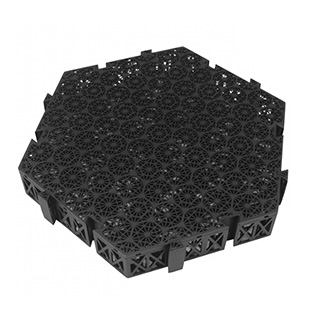
Five Coordinated Components
Component Formats for Adaptable Layouts
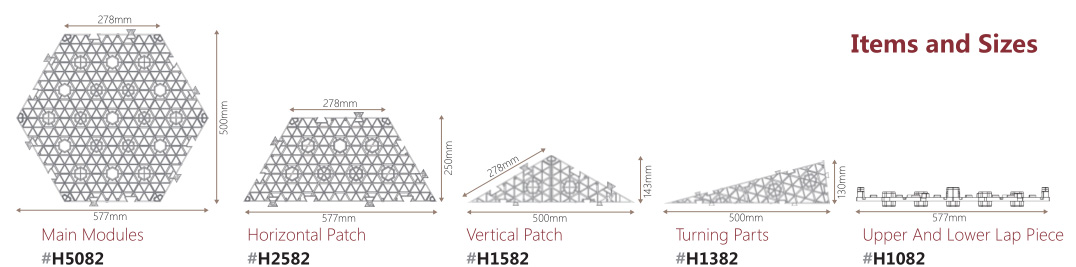
The five formats work together, so you can plan the components around the site footprint. Before ordering, use the dimensioned drawings to select each format and check the quantity.
- H5082
- H2582
- H1582
- H1082
- H1382
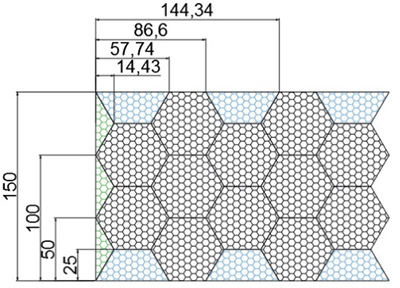
Component-layout references
- Length
- 25 cm increments
- Width
- 14.43 cm increments
- Layer depth
- 8.2 cm increments
- Rotation
- 15° increments
Published layouts include lengths such as 25, 50, 75 and 100 cm. Width examples also include 14.43, 28.9 and 43.3 cm. Depth examples include 8.2, 16.4 and 24.6 cm. However, use the component drawing for the exact layout dimensions.
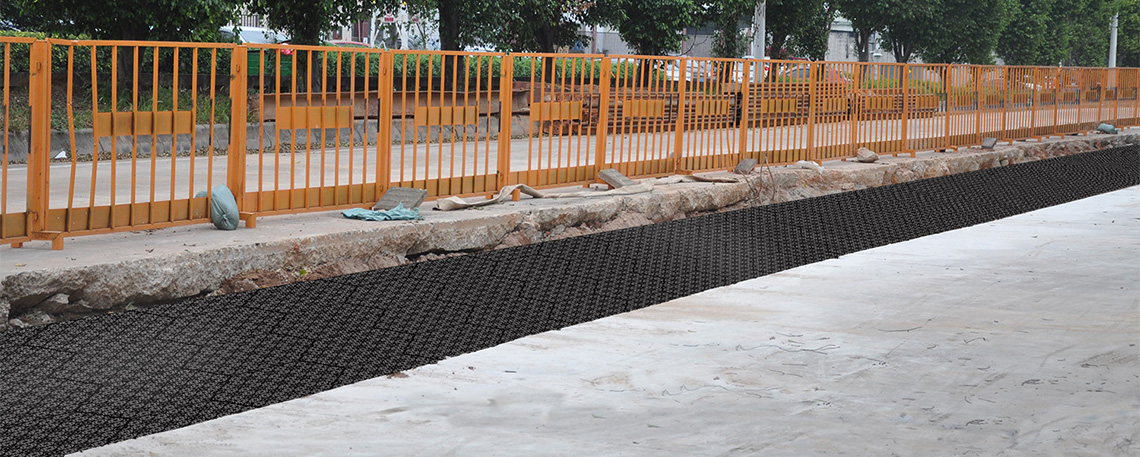
From Component to Finished Module
HOENSOEY Cells Inside HCR
HOENSOEY Cells form the internal hexagonal structure, while HCR brings the parts together in a regular finished module. As a result, the site team can plan around a clear size for handling and delivery.

Connected space for water movement
Connected spaces let water move through the cells. For example, the whole system can hold water or release it through an outlet. Water can also enter suitable ground if the design allows infiltration. Therefore, select the filters, membrane, pipes and base to suit the intended function.
A clear finished format
HCR-1000 is the standard 1000 × 1440 × 82 mm finished module. Because it arrives assembled, the site team can focus on placement and connection. HCR-2000 also provides a wider option for selected large-area projects. However, review the layout and handling needs before choosing that format.
Component Reference
H5082 Technical Data
These published values describe H5082, so use them to identify the component and the documents you need. However, they do not describe the design capacity of a complete HCR system.
| Item | Reference value |
|---|---|
| Dimensions (L × W × H) | 57.7 × 50 × 8.2 cm |
| Unit weight | 2.05 kg |
| Material | PP with polymer materials |
| Vertical compression | > 800 kN/m²; listed maximum 1330 kN/m² |
| Lateral compression | > 200 kN/m²; listed maximum 400 kN/m² |
| Void ratio | Approximately 95% |
| Perforated percentage | > 52% |
| Flow reference at 0.0% gradient | 50.2 L/(s·m²) |
| Flow reference at 2.0% gradient | 94.2 L/(s·m²) |
Match the document to the proposed arrangement
To begin with, identify the component model, material and tested arrangement. Then check the applied load and reporting units. Also read compression results with their deformation limits and test duration. Similarly, check the flow direction, gradient and layout for water-flow tests. Finally, compare these conditions with the planned use.
When preparing a specification, request the component drawing, material statement and compression report. Also ask for water-flow test conditions and service-life information for the intended exposure.
Connections and Installation
Assembly Around the Approved Layout
Six sets of horizontal and vertical connection points help align the parts during assembly. In addition, the built-in connectors allow assembly without extra tools. Check that each connection fully engages before adding the next part.
Published component information also describes six horizontal and two vertical assembly directions. You can align components in vertical layers as well as horizontal layouts. In either case, select the depth and connections to suit the structural and drainage design.
Before installation, prepare the component list and work sequence. Then mark changes in level, edge details and pipe connections on the drawings. Also include access and inspection needs, so the cellular layout fits the rest of the drainage system.
If you need complete modules, explore HCR-1000 stormwater storage modules. Then place and connect adjacent units tightly to form a continuous layer.
 Watch the Cells assembly video
Component Questions
Technical FAQ
These answers explain the components and their data. If you need module sizes, packing or supply planning, visit the HCR stormwater storage modules page.
What are HOENSOEY Cells?
HOENSOEY Cells are interlocking components for shallow drainage and rainwater management. Their six-sided structure creates connected spaces so water can move through the layout. In addition, these components form the inside of finished HCR modules.
Which component models are available?
Five formats are available, including H5082, H2582, H1582, H1082 and H1382. Before choosing a format, use the component drawing to check its place in the layout.
How do HOENSOEY Cells relate to HCR-1000?
HOENSOEY Cells provide the internal structure, while HCR-1000 is the complete 1000 × 1440 × 82 mm module. Because the module arrives assembled, the site team can handle and place it as a finished unit.
What are the H5082 reference dimensions?
Published H5082 dimensions are 57.7 × 50 × 8.2 cm. The component literature also lists a unit weight of 2.05 kg. However, these figures describe H5082, rather than a finished HCR module.
How should I use the compression and void-ratio values?
To begin with, treat them as Cells component references. Then check the test report, material grade, sample and loads before choosing a design value. However, the approximately 95% void ratio does not set the usable storage of a complete HCR installation.
Can I arrange the components in more than one layer?
Yes, components can align vertically to form multiple layers. However, the engineer must select the layer count and connections to suit the loads, drainage needs and installation plan.
How do I choose geotextiles and membranes?
Before choosing these materials, define the water-management function. Then select suitable filters, protection, a base and outlets to work with the cells. Also add a membrane where the system needs containment or waterproofing.
Technical Support
Request Component Data for Your Project
Send the component model, project location, intended use and loads. Also include the surface layers and any drawings. Then list the documents or test details you need, so we can address the proposed layout.
If you need a complete product and supply proposal, explore HCR stormwater storage modules. There you can review finished-module sizes, applications and delivery planning.