

Learning how to compare stormwater module systems starts with verified project requirements, not shape or broad claims of superiority. A useful comparison checks structural evidence, installed dimensions, hydraulic capacity, connections, construction needs, service conditions and supplier support.
HOENSOEY Cells provide one approach for shallow surface-water management. Other systems may suit different depths, loads or logistics. Therefore, the purpose of this guide is to help specifiers compare like with like and identify the evidence needed for a defensible decision.
In this guide
Introduction to Surface Water Management Systems
A surface water management system collects, conveys, stores, treats and releases or reuses runoff. Depending on the site, it may include inlets, pretreatment, modular storage, flow controls, infiltration components, inspection points and an emergency overflow.
The storage unit is important, but it is only one part of the system. The hydraulic model, ground investigation, structural design and maintenance plan must work together.
Role of Modular Water Storage Units
Modular units create underground void space for temporary storage or controlled water movement. In addition, a shallow configuration may reduce excavation where services, groundwater or formation levels restrict depth.
For reliable performance, the selected unit needs suitable load capacity, dimensional stability, hydraulic continuity and secure connections. The surrounding installation also needs the correct bedding, wrapping, backfill and access provisions.
HOENSOEY Cells Overview
HOENSOEY Cells use coordinated polypropylene components with an internal honeycomb structure and mechanical connections. The final system can be arranged in a practical project footprint. Published product information includes shallow dimensions, open storage and declared load data.
Because product data can change, use the current HOENSOEY Cells technical page and request the relevant drawing and test report before specification.
How to Compare Another Stormwater Module
A label such as “Product X” does not provide enough evidence for a fair comparison. Instead, ask every supplier for the same project-specific information. Then record the test method, declared value, limitations and document reference.
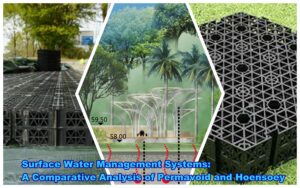
How to Compare Stormwater Module Systems
On small screens, scroll horizontally to read every column.
| Criterion | Evidence to request | Why it matters |
|---|---|---|
| Installed dimensions | Dimensioned drawing and component schedule | Confirms footprint, depth and usable volume. |
| Material | Material declaration and quality-control information | Supports durability and manufacturing consistency. |
| Vertical and lateral loads | Test report, test method and stated conditions | Helps the engineer check the proposed surface use. |
| Long-term behavior | Creep or long-duration design information | Separates short-term test values from service conditions. |
| Void ratio and storage | Verified void ratio and installed volume calculation | Supports the hydraulic model. |
| Flow properties | Hydraulic test data or design guidance | Shows how water moves through the connected system. |
| Connections | Horizontal and vertical connection details | Supports alignment and installation control. |
| Installation | Method statement, bedding, wrapping and backfill requirements | Reveals the complete construction process. |
| Maintenance | Pretreatment, inspection and cleaning guidance | Supports long-term operation. |
| Supply support | Lead time, packing plan, documentation and technical response | Reduces procurement and delivery risk. |
Performance and Installation Questions
First, confirm which load value is being quoted and under what test conditions. Next, check whether that value is appropriate for the actual cover depth, soil, pavement and traffic. Then review the installation tolerances and connection sequence. Finally, make sure site quality checks are defined.
Ease of installation should also be measured against the full process. Module assembly may be fast, yet excavation preparation, membrane work, pipe connections, inspection and backfilling remain part of the program.
Connectivity and Accessories
Connections should hold the planned alignment in horizontal and vertical directions. Useful accessories may include clips, join caps, inspection interfaces or transition details. However, more accessories do not automatically mean better performance. Each part should have a clear role on the approved drawing.
Packaging, Transport and Service Life
Compact transport can reduce handling and freight volume, while factory pre-assembly may reduce site labor. The better option depends on container planning, lifting access, local labor and the risk of damage in transit.
Guidance for Selection
- Start with the project: define water volume, footprint, depth, ground conditions and discharge objective.
- Check structural evidence: compare test methods and design conditions, not only maximum values.
- Calculate installed storage: use actual dimensions and verified void ratio.
- Review the complete installation: include bedding, wrapping, connections, access and backfill.
- Assess supplier support: request drawings, reports, packing data, lead time and technical assistance.
If the review identifies a deeper concentrated-storage requirement, compare the M2025 stormwater attenuation tank and the M2015 Flat-Pack module format. Keep the HOENSOEY Cells links for ultra-shallow distributed drainage applications.
Conclusion
A strong comparison makes every supplier answer the same technical questions. When teams know how to compare stormwater module systems, engineers and buyers can choose a system that fits the actual site rather than the loudest marketing claim.
Learn More
For current dimensions, load data, hydraulic information and component options, review the HOENSOEY Cells product information or contact HOENSOEY with the project requirements.