
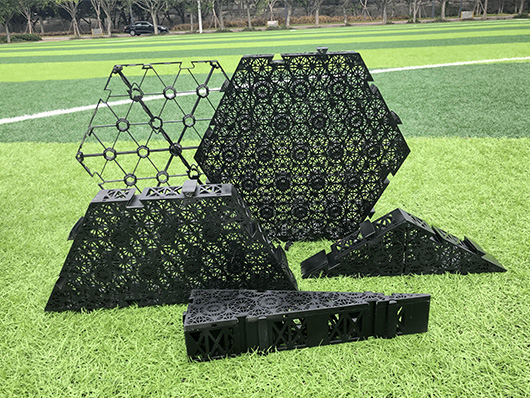
Ultra-shallow drainage design can help when a project has limited excavation depth, congested services or a need to manage water close to the surface. However, a shallow module is not a universal solution. The design still needs verified storage volume, load capacity, hydraulic controls and suitable ground conditions.
This guide explains where shallow modular storage can fit and what information a project team should review. After the depth constraints are defined, consult the 82 mm HOENSOEY Cells drainage system for current technical information.
In this guide

Where Ultra-Shallow Drainage Design Fits
Ultra-shallow stormwater storage uses a low-profile modular layer to receive, convey or temporarily store runoff. Depending on the project, the system may support attenuation, infiltration, passive irrigation or sub-surface drainage.
HOENSOEY Cells use coordinated modular components with an internal honeycomb structure. The completed arrangement can follow a practical project footprint. Therefore, customers can focus on dimensions, capacity and installation rather than an unfamiliar external shape.
Available-Depth Assessment
- Structural performance: check declared vertical and lateral loads against the intended surface use and cover build-up.
- Open storage: use the verified void ratio and installed dimensions to calculate available water volume.
- Connections: review horizontal and vertical locking details for the proposed arrangement.
- Material: request current material, quality-control and durability information.
- Hydraulic design: confirm inlets, outlets, flow control, pretreatment and maintenance access.
Published HOENSOEY information includes declared load and void-ratio data for the relevant product configuration. Nevertheless, the current technical sheet and supporting test report should be checked before specification.
Applications That Need Load and Water-Path Checks
Shallow modular systems can support several applications when the complete design is suitable:
- Road surface drainage: provides a shallow drainage or storage layer beneath an engineered pavement build-up.
- Green roofs: can store and redistribute water below the growing layer where the roof design allows it.
- Eco-landscapes: supports passive irrigation by keeping water near planted areas.
- Courtyards: helps route runoff toward storage, infiltration or landscape reuse zones.
- Athletic fields: supports rapid drainage below suitable synthetic or natural sports surfaces.

How the System Works
First, runoff enters through the designed surface or collection points. Next, pretreatment limits sediment entering the modular layer. Water then moves through the connected open structure. Finally, the design controls whether water is detained, infiltrated, reused or discharged.
The same component family can support three broad system roles:
- Pavement foundation and drainage: assists water movement and load distribution within a verified pavement design.
- Power-free green systems: stores water close to roots for passive redistribution where climate and planting design are suitable.
- Tree and road protection: maintains void space for air and water while supporting the engineered surface above.
When an 82 mm Cell Layer Is Relevant
Ultra-shallow drainage design may be appropriate when deep excavation is restricted, installation access is limited or the drainage function benefits from near-surface storage. In contrast, a deeper tank may be better when the project needs a large concentrated volume within a small plan area.
Before selecting either approach, compare available depth, footprint, ground conditions, groundwater, traffic loading, discharge requirements, maintenance access and total installed cost.
Engineering Information to Request
- The current technical data sheet and dimensioned configuration drawing.
- The component schedule and connection details for the proposed footprint.
- The load test method, declared values and stated test conditions.
- The verified void ratio and hydraulic information used in the design.
- The bedding, wrapping, backfill, inspection and maintenance requirements.
The internal honeycomb geometry supports repeated load paths and open water flow. The customer-facing system, however, can be planned as a regular assembled format. This distinction keeps the structural explanation accurate while making specification and installation easier to understand.
Conclusion
Ultra-shallow stormwater storage is most valuable when it solves a defined site constraint. A strong specification connects the module data to the hydraulic model, structural design and installation method. It should not rely on shape, marketing language or a single headline figure.
Send HOENSOEY the project footprint, available depth, surface loading and water-management objective, or review the HOENSOEY Cells technical information before discussing a suitable component arrangement.
