

Equestrian arenas need a coordinated ground design, not a product-only answer. Start with arena use, horse traffic, site levels, soil, rainfall, groundwater and a legal outlet. Then coordinate the subgrade, base, drainage, separation layers and riding surface. Finally, verify the installed work through inspection, testing and maintenance.
No GS-Grid or Hoensoey Cells component can guarantee a dry, safe, stable or durable arena. Those outcomes depend on the complete site and its operation. The responsible geotechnical, civil, structural and equestrian-surface specialists should confirm the design. They should also address local planning, drainage, environmental and safety requirements.
In this guide
Plan Equestrian Arenas as Complete Ground Systems
An arena surface changes under hoof loading, grooming, irrigation, rainfall and seasonal weather. Therefore, the design brief should name the disciplines, horses, activities and expected operating pattern. It should also record indoor or outdoor exposure, adjacent slopes, gates, fence lines, utilities and maintenance equipment.
The Penn State Extension guide to riding-arena footing explains that the footing depends on a suitable base and sub-base. It also discusses drainage, moisture and conditioning. The guide supports a layered planning approach; however, it does not approve a project or verify any HOENSOEY product.
The peer-reviewed University of Kentucky Cooperative Extension publication describes arena structure, footing characteristics and management considerations. Use it as educational context. Local professionals still need to interpret the site, riding discipline, horse welfare needs and current authority rules.
Define Use, Safety and Acceptance for Equestrian Arenas
Write an operating brief
First, record the intended disciplines, training intensity, competition use and non-riding traffic. Then identify the horses, riders, instructors, spectators and maintenance teams who may enter the area. In addition, map vehicles, gates, mounting zones, jumps, rails and storage interfaces.
Do not reduce safety to whether the arena looks flat or dry. Instead, the project team should define measurable acceptance checks for levels, drainage response, surface consistency and maintenance access. An equestrian-surface specialist should also assess traction, support, cushioning and shear response for the intended use.
Separate design aims from guarantees
A project may aim to reduce mud, ponding, ruts, dust or downtime. Nevertheless, each aim needs a baseline and an agreed observation method. Weather, irrigation, hoof traffic, grooming and material ageing can all change the result. Therefore, neither a component name nor a drawing alone proves long-term performance.
Investigate the Site Before Choosing Layers
Survey levels and water pathways
Start with a current topographic survey. Map the arena, approaches, surrounding ground, roofs, channels, inlets, utilities and receiving systems. Next, trace off-site water that could enter the arena. Also trace runoff from the completed surface toward its lawful destination and safe exceedance route.
Low spots, blocked edges and poorly coordinated thresholds can retain water even when a subsurface layer drains freely. Conversely, rapid subsurface transfer does not help if the outlet lacks capacity or permission. The drainage design must connect collection, conveyance, storage or discharge as one route.
Investigate soil, groundwater and contamination
A competent ground investigation should describe soil, fill, bearing behaviour, settlement risk and groundwater conditions at the required scale. It should also identify unsuitable or contaminated material. Then the designer can assess excavation, stabilization, separation, filtration and drainage options.
Do not infer ground capacity from a product image or a small trial outside the loaded area. Likewise, do not assume that infiltration suits every site. Nearby structures, slopes, utilities, groundwater and environmental receptors may require a controlled outlet, liner or another approved approach.
Coordinate Layers and Footing for Equestrian Arenas
Protect the formation and base
The subgrade and base provide geometry and support for the layers above. Therefore, the specification should define preparation, proofing, unsuitable-area treatment, compaction, tolerances and inspection. The design should also prevent fines from moving into open drainage paths where compatible separation or filtration is required.
Installation sequencing matters. Wet-weather trafficking can damage a prepared formation, while uncontrolled stockpiles can introduce contamination or variable moisture. Consequently, the inspection plan should identify hold points before each layer hides the previous work.
Match the riding surface to the complete build-up
The footing is not independent of the base. Particle size, shape, moisture response, depth and additives can alter traction, cushioning and maintenance. Thus, the equestrian-surface specialist should assess samples and define the grooming and moisture regime with the chosen build-up.
A surface that drains quickly may still become dusty or loose. Meanwhile, a moisture-holding surface may compact, rut or become slippery under other conditions. The design should address these trade-offs without promising one material as universally safe or low maintenance.
Design Drainage for Equestrian Arenas and Exceedance
Connect rainfall, collection and outlet evidence
For outdoor equestrian arenas, use the authority’s required rainfall data and assessment method. Define catchments, surface levels, infiltration assumptions, drainage interfaces and downstream conditions. Then show what happens during normal operation, blockage, saturation and rainfall beyond the selected design case.
The outlet needs legal permission and physical capacity. Furthermore, the design should avoid transferring erosion, pollution or flood risk to neighbours, roads, buildings or water bodies. Where runoff quality needs management, add the accepted collection, sediment and treatment measures before discharge or reuse.
Plan moisture management separately from disposal
Riding-surface moisture can influence dust and consistency. However, drainage and irrigation do different jobs. A capillary or passive-water concept still needs hydraulic evidence, compatible materials, controls and a commissioning method. It also needs a safe response to blockage, excess inflow, dry weather and maintenance.
Do not assume that a subsurface void automatically creates uniform surface humidity. Instead, verify water movement through the full build-up. Record observations across the arena, then adjust only within an approved operating plan.
Interpret GS-Grid and Hoensoey Cells Claims for Equestrian Arenas
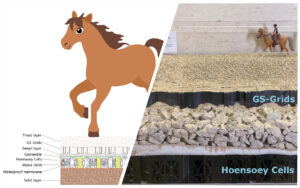
The following manufacturer passage and image remain for source continuity. They describe the supplier’s historical position, not verified performance for a particular project.
As suppliers of advanced equestrian ground solutions, we at Hoensoey Technology Co., Ltd., understand the critical challenges faced by arena managers and equestrian enthusiasts. Recognizing the need for a superior-quality arena ground, we have developed an integrated system that addresses common issues such as waterlogging, mud, and uneven terrain. Our innovative combination of the GS-Grid horse paddock mud control grid and Hoensoey Cells technology offers a revolutionary approach to arena ground reinforcement and drainage.
Review the Manufacturer-Described Challenge Claims
The next list is preserved byte-for-byte as historical manufacturer copy. The limits after it govern how a project team should use those claims.
Challenges and Our Solutions:
- Waterlogging and Mud: Our system effectively combats the seasonal challenge of waterlogging and mud. The synergistic action of the GS-Grid and Hoensoey Cells ensures swift drainage, keeping the arena dry and safe, even after heavy rainfall. This feature significantly enhances the usability and safety of the arena.
- Uneven Ground: The structural integrity provided by our combined solution ensures a solid and flat surface, crucial for the safety and performance of horses. Our system is designed to withstand the weight and dynamic movements of horses, providing a stable platform for training and competition.
- Maintenance Cost Efficiency: Traditional arena grounds require frequent and costly upkeep. Our durable solution requires minimal maintenance, significantly reducing long-term expenses and labor.
- Eco-Friendly Durability: We prioritize environmental sustainability. The high-quality HDPE material of our GS-Grid system resists ammonia corrosion and prevents cracking, ensuring a long service life while being eco-friendly.
- Ease of Installation: Our systems are designed for quick and efficient installation. The patented slot connectors of the GS-Grid and the simple splicing design of Hoensoey Cells make the installation process manageable, saving considerable time and labor costs.
- Multifunctional Applications: Beyond equestrian arenas, our system is versatile enough for use in stables, walkways, and other areas requiring ground reinforcement and drainage. This adaptability ensures uniform ground quality across various applications within equestrian facilities.
For safety and stability, require project-specific geotechnical and equestrian-surface evidence. Review the exact materials, exposures, joints and replacement plan for durability. Define a life-cycle boundary and accepted comparison for environmental claims. Finally, compare installation and maintenance through documented quantities, access, labour, plant and inspection needs.
Compare Four Manufacturer-Described Layouts for Equestrian Arenas
The source presents four conceptual methods. They remain in their original order below; however, they are not construction details or verified alternatives.
To cater to diverse field conditions and requirements, we propose the following implementation methods:
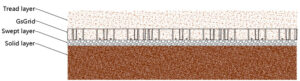
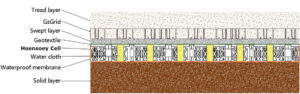
- Method 1: A cost-effective ground reinforcement solution that effectively manages mud. While excellent for stabilizing the ground, this method’s drainage capacity may be somewhat limited under extreme weather conditions.
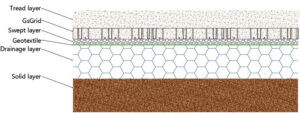
- Method 2: Enhances drainage over Method 1 with an additional layer. This approach requires deeper excavation and more materials but offers a more reliable and stable ground in the long term. The quality of drainage materials is crucial to prevent potential sagging.
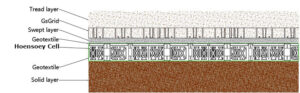
- Method 3: Utilizing Hoensoey Cells as the drainage layer is the optimal solution for water management. This method involves shallow excavation, cost savings, and provides ample drainage space for rapid drying of the ground.
- Method 4: Builds upon Method 3 by creating an ideal moisture balance on the sand surface through Hoensoey Cells’ capillary action. This passive irrigation system allows for adjustable humidity levels, enhancing the comfort of horses and minimizing track dust.
Use a common comparison basis
Method 1 needs evidence for ground reinforcement, mud response and the stated extreme-weather limit. Method 2 needs the same evidence plus compatible drainage materials, settlement control and proof for its reliability claim. Neither cost-effectiveness nor long-term stability follows from the diagram alone.
Method 3 labels one layout optimal and links it to shallow excavation, cost savings, drainage space and rapid drying. Treat every one of those phrases as an unverified manufacturer description. Site levels, required excavation, connected outlet capacity, material quantities and measured drying response may lead to a different result.
Method 4 adds capillary action, ideal moisture balance, adjustable humidity, horse comfort and dust reduction. Those outcomes depend on water level, material compatibility, surface selection, climate, controls and operation. Therefore, require physical testing and an agreed commissioning plan before specifying that function.
Request evidence for the exact product and interface
- Identity: exact model, material, recycled content if claimed, dimensions, connectors and traceability.
- Loads: applicable test method, boundary conditions, support condition, repeated loading and project interpretation.
- Water: void and flow data, test configuration, filtration interfaces, outlet connection and blockage response.
- Durability: relevant chemical, temperature, ultraviolet, creep, joint and installation evidence.
- Construction: formation criteria, tolerances, cutting, edges, transitions, protection, inspection and repair.
- Operations: access, cleaning, grooming limits, monitoring, replacement and end-of-life responsibility.
Project professionals should review the evidence against the selected build-up. If a data gap affects safety, drainage, stability or durability, resolve it before procurement. A substitution also needs renewed review because similar-looking products may use different materials, joints or test conditions.
Commission and Maintain Equestrian Arenas
Inspect hidden work before covering it
Record the formation, levels, compaction, separation layers, drains, joints, edges, outlets and cleanouts before they disappear. In addition, photograph and locate each inspection point. The handover file should connect as-built records to product batches, tests, nonconformities and approved repairs.
Commissioning should test the connected route, not merely wet one visible area. Use the approved method and protect horses, people, structures and receiving systems during testing. Then record the initial surface condition and any adjustments to moisture or grooming.
Use observations to trigger action
The maintenance plan should cover surface redistribution, moisture, sediment, inlets, drains, outlets, edges and surrounding runoff controls. It should name the person responsible for each task. It should also define how staff record ponding, ruts, soft areas, dust, material migration or changing horse response.
After heavy weather, unusual use or a visible defect, restrict access when safety remains uncertain. Next, inspect the whole pathway and compare conditions with the acceptance record. Do not attribute every defect to drainage; surface, base, installation, irrigation and maintenance causes may overlap.
Equestrian Arenas: Design and Approval Checklist
- Freeze the arena use, riding disciplines, traffic, safety aims and maintenance resources.
- Survey levels, thresholds, surrounding catchments, utilities, structures and legal outlets.
- Investigate soil, fill, groundwater, settlement, contamination and nearby receptors.
- Define rainfall, drainage, water-quality and exceedance criteria with the relevant authority.
- Coordinate the subgrade, base, filtration, drainage, edges and riding surface.
- Assess traction, support, cushioning and moisture through the responsible equestrian specialist.
- Verify exact product data and every interface; do not extrapolate from a family name.
- Inspect hidden work, commission the connected system and retain as-built evidence.
- Assign grooming, moisture, sediment, drainage and defect-response responsibilities.
- Reassess the design after material substitution, site drift or changed arena use.
Historical Conclusion and Manufacturer Routes
The closing source copy remains below for continuity. It is a manufacturer statement, not an independent endorsement.
Conclusion
By choosing our GS-Grid combined with Hoensoey Cells technology, you’re opting for a ground-breaking solution that addresses long-standing issues in equestrian arenas. Our system ensures a safer, more comfortable environment for horses and riders.
Visit Hoensoey Technology Co., Ltd. to explore our solutions and join us in building your ideal equestrian arena.
Additional Information:
- Horse Paddock Mud Control Grid: Our patented system, made of high-quality HDPE material, offers a stable surface, effectively combating wet and muddy conditions.
- Hoensoey Cells: Also made from premium PP, these cells provide efficient ground water drainage, preventing waterlogging and ensuring a dry arena surface.
Hoensoey Cells or a GS-Grid-family component may form one selected layer within a verified arena. Neither product family is a complete equestrian ground system. Site investigation, specialist design, approved drainage, installation control, commissioning and maintenance remain essential.
Conclusion
Good equestrian arenas connect riding needs with ground, water and maintenance evidence. Begin with the site and the horses, then coordinate every layer and outlet. Finally, verify the installed system and keep records as conditions change.
Use manufacturer information to compare defined components, not to guarantee whole-arena results. The project team should confirm safety, stability, durability, drainage and approvals for the actual location and intended use.